
Turunç macunu (bitter orange preserve)
- Feb 1
- 4 min read
Updated: Apr 4
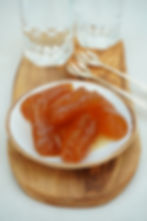
Turunç macunu is a traditional Cypriot bitter orange preserve, also known as a spoon sweet. Pronounced 'too-roonch muh-joo-noo', it is deeply fragrant, with floral, citrus aromas and a gentle sweetness from the syrup. As the peels are first soaked in water to remove excess bitterness, the finished preserve is lighter and less sharp than marmalade. The spoon sweet is served to guests alongside a glass of cold water, as a sign of hospitality.
Turunç macunu is made when bitter oranges are in season across Cyprus, which is usually throughout January and February. The fruit has a wonderfully aromatic, firm, thick peel that's perfect for simmering in syrup. The variety grown in Cyprus is similar to Seville oranges, and is why we use them in our recipe. Bergamot oranges can also be used for an alternative flavour.

The thin, shiny outer layer of zest is first gently removed with the finest side of a grater, before scoring each fruit vertically into 3 sections to carefully remove the peels. We use medium-sized Seville oranges in our recipe that are about 7 to 8cm in width. If you use larger oranges, you may need to score them into 4 sections. 1kg of Seville oranges yields roughly 350 to 400g of peel. You can also dry the grated peel and use it in cakes to add a wonderful aroma.
Once the peels are removed, the stringy pith is gently scraped away, before rolling each peel from top to bottom to create the classic shape of the spoon sweet. Once rolled, the peels are stitched together with cotton thread to hold them in place. They are then soaked in water for 4 to 5 days to remove excess bitterness, where the water is changed every day.

After the soaking process, the peels are boiled 3 times, before the cotton strings are removed. After this, the peels are soaked in lemon juice for 30 minutes to help them stay firm and hold their shape when slowly simmering in syrup for 2 to 3 hours. Once ready, the peels become tender and translucent. The wide range in cooking time comes from differences in the thickness of the orange peel. Thinner peels soften more quickly, while thicker peels need longer to become tender and translucent. When ready, the syrup should have a consistency similar to runny honey, and a light foam will form on the surface during cooking.
Guests can either drink the glass of cold water served alongside turunç macunu, or dip the spoon sweet briefly into the water to remove excess syrup before eating. For an alternative sweet preserve, try ayva macunu (candied quince).
Makes approx 30 pieces | Preparation time: 1 hour | Cooking time: 3 to 4 hours | Additional time: 4 to 5 days for de-bittering (soaking)
Ingredients
10 (1kg) medium-sized Seville oranges (or another bitter orange variety), washed well | 1kg white sugar |
1L water | 100ml fresh lemon juice |
Fresh water for de-bittering |
Hob heat settings

Method
Bitter orange preparation
Using the finest side of a grater, gently remove a thin layer of zest from each orange. You want to remove just the shiny outer layer of the skin so that the syrup can be absorbed. Take care not to grate too deeply.

Using a knife, score each fruit vertically into 3 sections, from top to bottom, then carefully remove the peel. You can remove the small pip at the top if present.
Using a knife, gently remove the stringy inner pith from each peel. Avoid scraping away the white flesh of the peel itself.
Starting from the bottom, roll each peel tightly inwards towards the top. Secure it with a strong cotton thread and needle, stitching through the roll 2 to 3 times so it holds firmly. This is important, as the rolls can loosen when water is added and they swell up. Thread multiple rolled peels onto the same length of string, one after another, then tie the ends securely.

Place the prepared peels into a large bowl and add enough fresh water to cover. Add a small plate on top to weigh the peels down. You will need to drain and refill with fresh water each day for 4 to 5 days. This works to remove the bitterness.
Cooking and final preparation
Put a small plate in the freezer - this will be used later to test the syrup.
Drain the water and place the stringed peels in a large saucepan. Cover with fresh water and bring to the boil over a high heat. Boil for 5 minutes, then drain. Repeat twice more with fresh water each time.
Drain the peels and rinse under cold water until cool to the touch. Gently remove the strings by cutting them away with a knife, then place the peels in a large bowl. Add the lemon juice and gently rub it over the outside of the peels (don’t unroll them). Leave the peels in the lemon juice for 30 minutes.
Stir the sugar with 1 litre of water in a large saucepan until fully dissolved, then place on a high heat. Boil while loosely covered until there is a rolling simmer - about 15-20 minutes.
Using your hands, gently squeeze out the excess water and lemon juice from each peel and place them in the boiling syrup. Boil the peels for 5 minutes at a high heat, before lowering to a medium heat. Continue to simmer for 2 to 3 hours, or until the peels are tender and the syrup has thickened to a glossy, golden-orange colour. A foam should also develop, which will disappear once the syrup settles.
To test if the preserve is ready, add half a teaspoon (3-4 drops) of the syrup to the cold plate from the freezer and leave for 1 minute to cool. It should thicken so that when you lift the plate up vertically it has the consistency of runny honey. If it is watery, simmer for 10-15 minutes more or until firmer when re-tested.
Add to a large sterile jar, seal and allow to cool completely before storing in the fridge.
Serve a piece of turunç macunu with a glass of water on the side.